
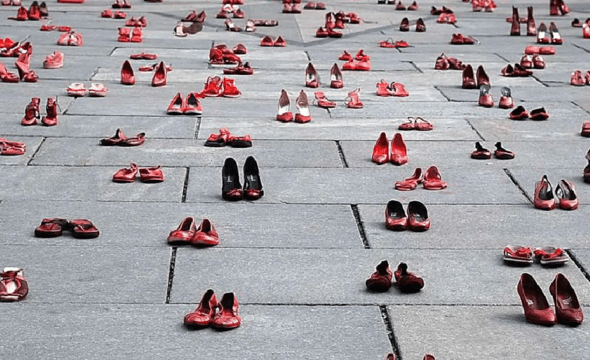
Photo: European Data Journalism Network. Red shoes represents the symbol of November 25th, the International Day for the Elimination of Violence against Women
In late March 2025, two 22 years old student girls from Italy, Sara Campanella and Ilaria Sula left the house but never came back home again. Sara was stabbed at a bus stop in Sicilian City Messina and Ilaria was found in a suitcase in a forested area outside of Rome, Italy.
A total of 99 femicides were monitored in 2025 by the Italian National Institute of Statistics, only in Italy. The broad number in the European context is shocking. For instance, in 2024, gender-related killings of women and girls (femicide) concerns 2.100 women and girls (United Nations Office on Drugs and Crime, UN Women, 2025), while in 2023, nearly 749 women died as a result of physical, intimate, and gender-based violence, in 17 Member States of the European Union (Zamfir, 2025, p.4).
Femicide claims the lives of 18 women per week in the European Union (European Commission. (2026). Gender equality strategy 2026–2030). Every day, 137 women and girls are killed worldwide by their intimate partners or family members. Global issues of our time, feminicide have been, over the past decade, progressively recognised as a worldwide violent phenomenon, “probably the most pervasive yet least recognized human rights violation (United Nations Office on Drugs and Crime; UN Women, 2025)”.
What is Femicide?
Femicide is the most extreme form of gender-based violence. It can be defined as “the intentional killing of women and girls because of their gender” (Weil et al., 2018, pg1).
Feminicide’s term appears with the sociologist Diana Russell before the International Tribunal on Crimes Against Women in Brussels (1976) (Widyono, 2008). In recent years, international organizations and conventions have clarified the nature, the components and the motivations of the femicide against women. In 2012, the Vienna Declaration on Femicide elaborated a typology of eleven forms that femicide can take but this violence is characterized by three immutable components:
(1) its intimate nature; (2) its gendered dimension; and (3) its violent and lethal aspect (Campbell & Runyan, 1998).
Europe acts on gender-based violence – but not on femicide
In recent years, the European Union has intensified its efforts to combat violence against women. New directives, policy frameworks, and strategies, particularly in the post-#MeToo context, signals a growing political commitment to gender equality.
Despite this, Europe reveals a striking contradiction: it acts, but does not name. It regulates, but does not directly confront femicide as a distinct phenomenon.
The European Union does not explicitly define a specific legal or policy framework dedicated to preventing femicide. Instead, femicide is mentioned only indirectly, without being established as a legal category or operational framework. The Gender Equality Strategy 2026-2030 emphasises the need to strengthen institutional responses to violence against women by improving the capacity of law enforcement and prosecution authorities to detect risks and intervene effectively (European Commission, 2026). However, these measures remain framed within general violence prevention, without explicitly addressing femicide as a distinct category.
Two key frameworks currently shape European action:
Even though femicide is mentioned in passing in Article 9 of the 2024 Directive on Violence Against Women, it is not defined as a distinct legal category nor translated into a specific prevention and data-collection framework.
Even if these two instruments represent important milestones in the European Union’s gender equality agenda, neither explicitly defines or criminalises femicide. Therefore, this absence has structural consequences.
Institutional and Structural Implications of Femicide Non-Recognition
First of all, Femicide remains statistically and politically invisible. There are some meanings because femicide is not formally defined at EU level. Femicide cases are not consistently recorded across Member States and data collection remains fragmented. The scale of the phenomenon is difficult to fully capture at European level.
As a result, femicide is often absorbed into broader categories of gender-based violence, limiting its visibility as a distinct structural phenomenon.
Frameworks remain general rather than targeted. The absence of a specific legal category also shapes prevention approaches. Instead of targeted strategies addressing femicide specifically, current EU tools tend to focus broadly on violence against women and rely on general prevention and protection mechanisms, and lack harmonised risk-assessment systems focused on lethal violence. This means femicide is addressed indirectly, rather than as a specific form of violence requiring tailored intervention.
Implementation gaps weaken existing tools. Recent monitoring by GREVIO (the Group of Experts on Action against Violence against Women and Domestic Violence of the Council of Europe) highlights that many member states do not systematically review domestic homicide cases. They lack effective risk-assessment mechanisms and fail to coordinate prevention across institutions. At the same time, structural barriers persist, including: lack of reliable data, bureaucratic difficulties in classifying femicide cases and limited political willingness to explicitly name the phenomenon.
Abovementioned consequences create a clear paradox: the EU positions itself as a global leader in gender equality, yet struggles to fully address one of its most extreme forms of gender-based violence.
Summary
The European Union has developed several legal and policy instruments to address violence against women, especially in the past decade. However, these measures remain fragmented, often embedded in general equality strategies. They tend to overlook the specific and structural nature of femicide.
Even if there is growing political attention, femicide is still not recognised as a distinct legal category at the European level. It is therefore addressed indirectly, without a coherent framework that fully captures its specificity and ensures consistent implementation across Member States.
In this context, explicitly recognising femicide as a distinct form of violence would be an important step forward. Equally important is strengthening existing instruments through targeted, survivor-centred, and evidence-based approaches, many of which have already been proposed by feminist and civil society organisations.
While WIDE+ is not a specialised organisation on femicide, it engages with these issues as part of its broader work on gender equality and feminist policy analysis. From this perspective, NGO and monitoring body findings consistently point in the same direction: without political will and clear structural recognition, prevention efforts will remain partial and limited.
Reducing femicide in Europe requires more than policy commitment. It requires a shift from fragmented responses to a clear, coordinated approach that treats femicide not simply as an extension of gender-based violence, but as a structural phenomenon in its own right.
As global data continues to show, the urgency is undeniable – every 10 minutes, a woman is killed by a partner or family member (UNODC, 2025).
This article is based on “Femicide: One Is Not Born a Woman but Dies as One: A European Paradox”, developed by our intern, Laura Cargnello.